数学の分野である代数学において、多元環や群などの中心 (英: center, 独: Zentrum) は考えている構造の部分集合であって、乗法に関してすべての元と交換する元全体からなる。

群の中心

G {\displaystyle G} を群とすると、その中心は集合

Z ( G ) := { z G g G : g z = z g } {\displaystyle \mathrm {Z} (G):=\{z\in G\mid \forall g\in G:gz=zg\}}

である。

性質

G {\displaystyle G} の中心は部分群である。なぜならば、 x {\displaystyle x} y {\displaystyle y} Z ( G ) {\displaystyle Z(G)} の元とすると、任意の g G {\displaystyle g\in G} に対して、

( x y ) g = x ( y g ) = x ( g y ) = ( x g ) y = ( g x ) y = g ( x y ) {\displaystyle (xy)g=x(yg)=x(gy)=(xg)y=(gx)y=g(xy)}

なので、 x y {\displaystyle xy} も中心に入る。同様にして、 x 1 {\displaystyle x^{-1}} も中心に入る。

x 1 g = ( g 1 x ) 1 = ( x g 1 ) 1 = g x 1 {\displaystyle x^{-1}g=(g^{-1}x)^{-1}=(xg^{-1})^{-1}=gx^{-1}} .

群の単位元 e {\displaystyle e} は常に中心に入る。 e g = g = g e {\displaystyle eg=g=ge} .

中心はアーベル群で G {\displaystyle G} の正規部分群である。 G {\displaystyle G} の特性部分群でもある、つまりすべての自己同型で不変である。中心は強特性 (strictly characteristic) でさえある、つまりすべての全射自己準同型で不変である。 G {\displaystyle G} がアーベル群であることと Z ( G ) = G {\displaystyle Z(G)=G} は同値である。

中心はちょうど、 z {\displaystyle z} による共役、すなわち ( g z 1 g z ) {\displaystyle \left(g\mapsto z^{-1}gz\right)} が恒等写像であるような、 G {\displaystyle G} の元 z {\displaystyle z} からなる。したがって中心を中心化群の特別な場合としても定義できる。 C G ( G ) = Z ( G ) {\displaystyle C_{G}(G)=Z(G)} である。

  • 3次対称群 S 3 = { i d , ( 1 2 ) , ( 1 3 ) , ( 2 3 ) , ( 1 2 3 ) , ( 1 3 2 ) } {\displaystyle S_{3}=\left\{\mathrm {id} ,(1\;2),(1\;3),(2\;3),(1\;2\;3),(1\;3\;2)\right\}} の中心は単位元 i d {\displaystyle \mathrm {id} } のみからなる、なぜならば:
( 1 2 ) ( 1 3 ) = ( 1 3 2 ) ( 1 3 ) ( 1 2 ) = ( 1 2 3 ) {\displaystyle (1\;2)(1\;3)=(1\;3\;2)\neq (1\;3)(1\;2)=(1\;2\;3)}
( 1 2 ) ( 2 3 ) = ( 1 2 3 ) ( 2 3 ) ( 1 2 ) = ( 1 3 2 ) {\displaystyle (1\;2)(2\;3)=(1\;2\;3)\neq (2\;3)(1\;2)=(1\;3\;2)}
( 1 2 3 ) ( 1 2 ) = ( 1 3 ) ( 1 2 ) ( 1 2 3 ) = ( 2 3 ) {\displaystyle (1\;2\;3)(1\;2)=(1\;3)\neq (1\;2)(1\;2\;3)=(2\;3)}
( 1 3 2 ) ( 1 2 ) = ( 2 3 ) ( 1 2 ) ( 1 3 2 ) = ( 1 3 ) {\displaystyle (1\;3\;2)(1\;2)=(2\;3)\neq (1\;2)(1\;3\;2)=(1\;3)}
  • 二面体群 D 4 {\displaystyle D_{4}} は正方形が全く動かないような平面の動きからなる。それは正方形の中心を中心とする角度 0°, 90°, 180°, 270°の回転と、2つの対角線および正方形の平行する辺の中点を通る2つの直線による4つの鏡映からなる。この群の中心はちょうど 0°と 180°の2つの回転からなる。
  • 実数を成分に持つ可逆 n×n-行列の乗法群の中心は単位行列の(0 でない)実数倍からなる。

環の中心

R中心は環の元であってすべての元と交換するものからなる。

Z ( R ) = { z R z a = a z   for all   a R } . {\displaystyle \mathrm {Z} (R)=\{z\in R\mid za=az\ {\text{for all}}\ a\in R\}.}

中心 Z ( R ) {\displaystyle Z(R)} R の可換な部分環である。環が中心と等しいことと可換であることは同値である。

結合多元環の中心

結合多元環 A中心は可換な部分多元環

Z ( A ) = { z A z a = a z   for all   a A } {\displaystyle \mathrm {Z} (A)=\{z\in A\mid za=az\ {\text{for all}}\ a\in A\}}

である。多元環がその中心と等しいことと可換であることは同値である。

リー代数の中心

定義

リー代数 g {\displaystyle {\mathfrak {g}}} 中心は(可換な)イデアル

z ( g ) = { z g [ x , z ] = 0   for all   x g } {\displaystyle {\mathfrak {z}}({\mathfrak {g}})=\{z\in {\mathfrak {g}}\mid [x,z]=0\ {\text{for all}}\ x\in {\mathfrak {g}}\}}

である。ただし [ , ] {\displaystyle [\cdot ,\cdot ]} はブラケット積、つまり g {\displaystyle {\mathfrak {g}}} の積を表す。リー代数がその中心に等しいことと可換であることは同値である。

  • 一般線型群 G L ( n , K ) {\displaystyle \mathrm {GL} (n,K)} の中心は単位行列 E n {\displaystyle E_{n}} のスカラー倍からなる。
Z ( G L ( n , K ) ) = { λ E n : λ K } {\displaystyle Z\left(\mathrm {GL} (n,K)\right)=\{\lambda E_{n}\colon \lambda \in K^{*}\}} .
  • 交換子をブラケット積とする結合多元環に対して2つの中心の概念は一致する。

参考文献

  • Kurt Meyberg: Algebra - Teil 1. Hanser 1980, ISBN 3-446-13079-9, S. 36

外部リンク

  • Centre of a group (Encyclopaedia of Mathematics)
  • Centre of a ring (Encyclopaedia of Mathematics)
  • Zentrum in verschiedenen algebraischen Strukturen (PlanetMath)
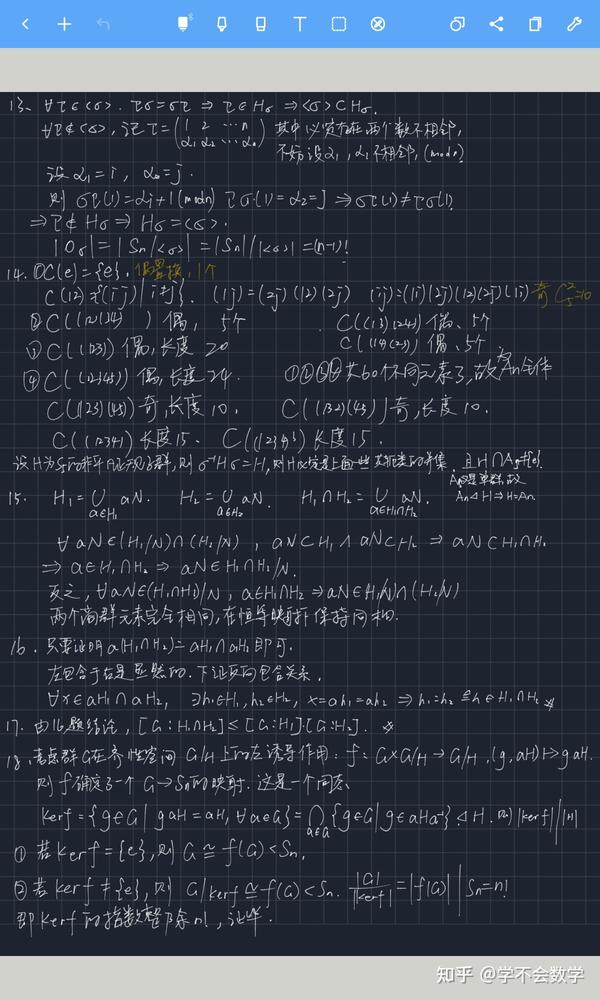
《代数学引论》第二章——习题解答(1) 知乎

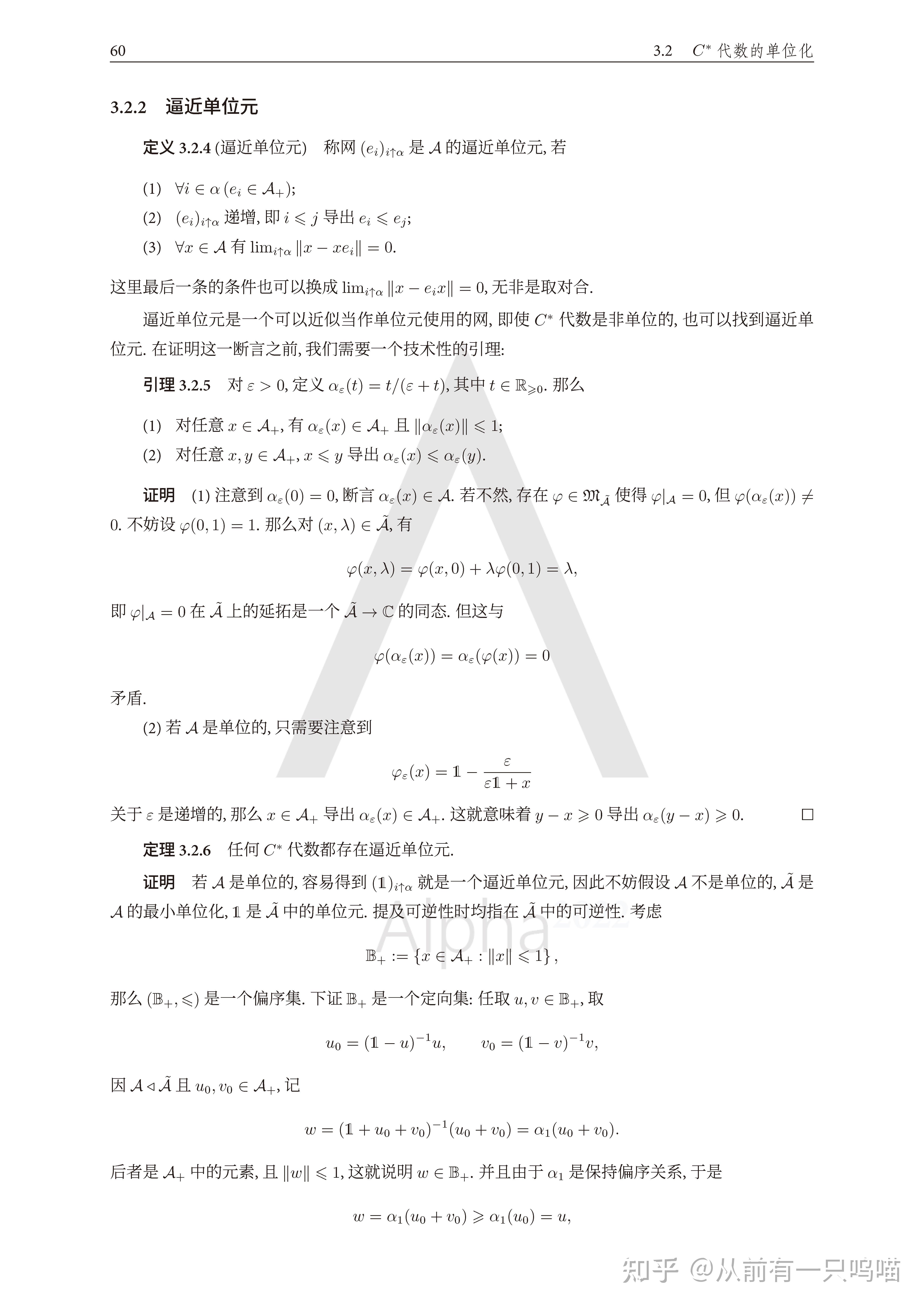
算子代数III:C*代数 一些杂七杂八的基本理论 知乎

初中数学竞赛题,所求代数式和已知条件看不出有何联系。math 初中数学 数学 中国 YouTube

代数式求值,观察题目换元法事半功倍.math 初中数学 数学 中国 YouTube

算子代数III:C*代数 一些杂七杂八的基本理论 知乎